A department, not a vendor
Has this company ever had a technology and marketing department? Not a web guy. Not an agency on retainer. A department. Almost no owner-led builder has, and that's why the work gets farmed out in pieces that never compound.
The Department is Kyle in three seats inside your company: CTO, CMO, and estimator. The front end gets built, the office learns to run it, and the dev team stays. You pay a base that reads like a fraction of one salary, every bid is inside it, and three percent is owed only on the jobs we source that close.
The seat is what buys the rate down. Every other door pays five percent of the contract when a bid on the close signs — a job we brought you, or your own job taken at nothing up front. Hold this seat and it is three on the jobs we source, and your own bids are inside the base. On eight million closed in a year that difference is a hundred and sixty thousand dollars — more than the base costs.
Two seats are open at a time. One builder per territory, held as long as the seat is filled.
Everything on the Bid Room rate card is inside the seat — every bid package, Interior Complete, the document suite, and the Portal.
- CTO seat — the front end from lead to signed contract: brand, Bid Room, estimator desk, Quick Estimator, Portal, CRM and follow-up, lead capture, and the outreach engine pointed at your territory
- CMO seat — pipeline: ads, reels, prospect pages, outbound, follow-up
- Estimator seat — AI takeoff to a formatted estimate; you verify and own every number
- The office program — weeks one and two, setup and the first bid together; weeks three and four, your office runs one while we watch; then a weekly office hour and a monthly scorecard
- Five playbooks — bid in five days · follow-up that closes · takeoff to verified estimate · AI for the office (email, sub comms, schedules, RFIs) · portal etiquette
- The scorecard — time-to-bid, bids sent, close rate, pipeline in the CRM, and jobs we sourced that closed. The last one is the commission base and it is reported on its own line, so the math is never an argument.
- The dev team — whatever the office needs next gets built
The office ships this, on your name
Weeks one and two we build the first one together. Weeks three and four your office builds one while we watch. After that this comes out of your building, not ours.
Example · Produced under the seat
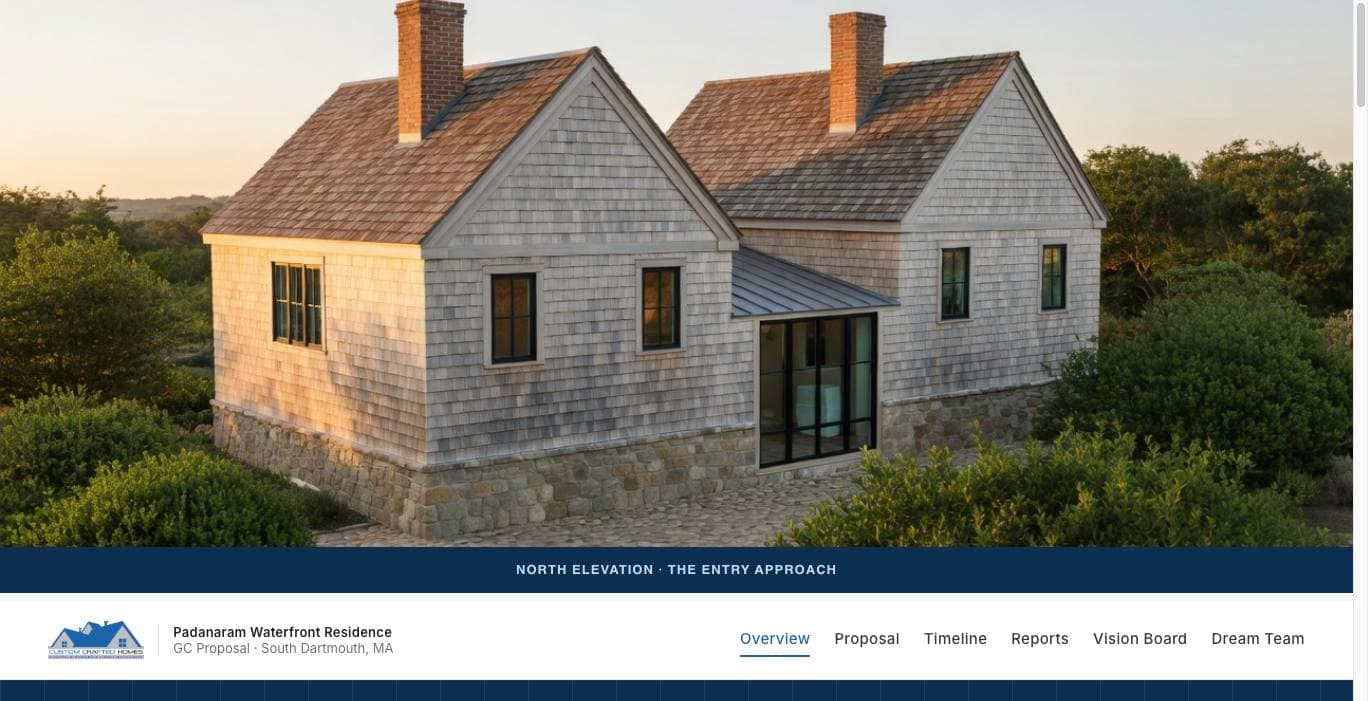
A bid room your office can run
Overview, proposal, timeline, reports, vision board, team. Five business days from the plan set, and every word approved by you before a client sees it.
The estimator seat sits behind it — AI takeoff to a formatted estimate that you verify and own. The scorecard measures what closed through it, which is also the commission base, so the math is never an argument.
We check you out before we take the seat
The seat is one builder per territory and two open at a time, and on the commission side we build and pay for bids before we are paid anything. So we look first. This is the whole check — there is nothing behind it you will not be told.
Registered to build where you build, and current. General liability and workers' compensation at or above our stated limits, with certificates we can read. This is the quick half, and it is usually done the same day.
Completed projects we can confirm, references we can actually reach, and a public review record we can read. Not a portfolio — a trading history. If your reputation is real, this part is easy and it is the part that gets you in.
We run a check before we grant it. We produce bids and source clients on our own money and get paid on your close, so how you pay people is the thing we are actually buying.
Nothing outstanding on anything we have already done. If you are new to us, this one is free.
Tell us who you are and we will come back with a yes, a no, or the one thing standing in the way. No call required to find out.