A yes isn't a job.
Three signatures are.
Between an accepted bid and the first day on site there is a letter of intent, a design agreement, and the construction agreement. Most builders have one of the three, written years ago, with the last client's name still in it. This is all three — in your brand, generated the same way every time. Before any of them there is the preliminary estimate, the one nobody signs.
Weeks of budget development, sub coordination and vendor pricing — unpaid, unreserved, and revocable by a phone call.
No letter of intentYou draw it, they take the set to price it elsewhere, and the builder who did the thinking bids against his own plan.
No design agreementTwo pages, no draw schedule, no change-order clause, no named drawing set. Then the conversation at draw five.
No real construction agreementThree documents, in the order money moves
Each one ends in a signature and a payment. Each one names the next and says what it replaces, so the owner is never unsure what they're holding — every page carries the same stage strip.
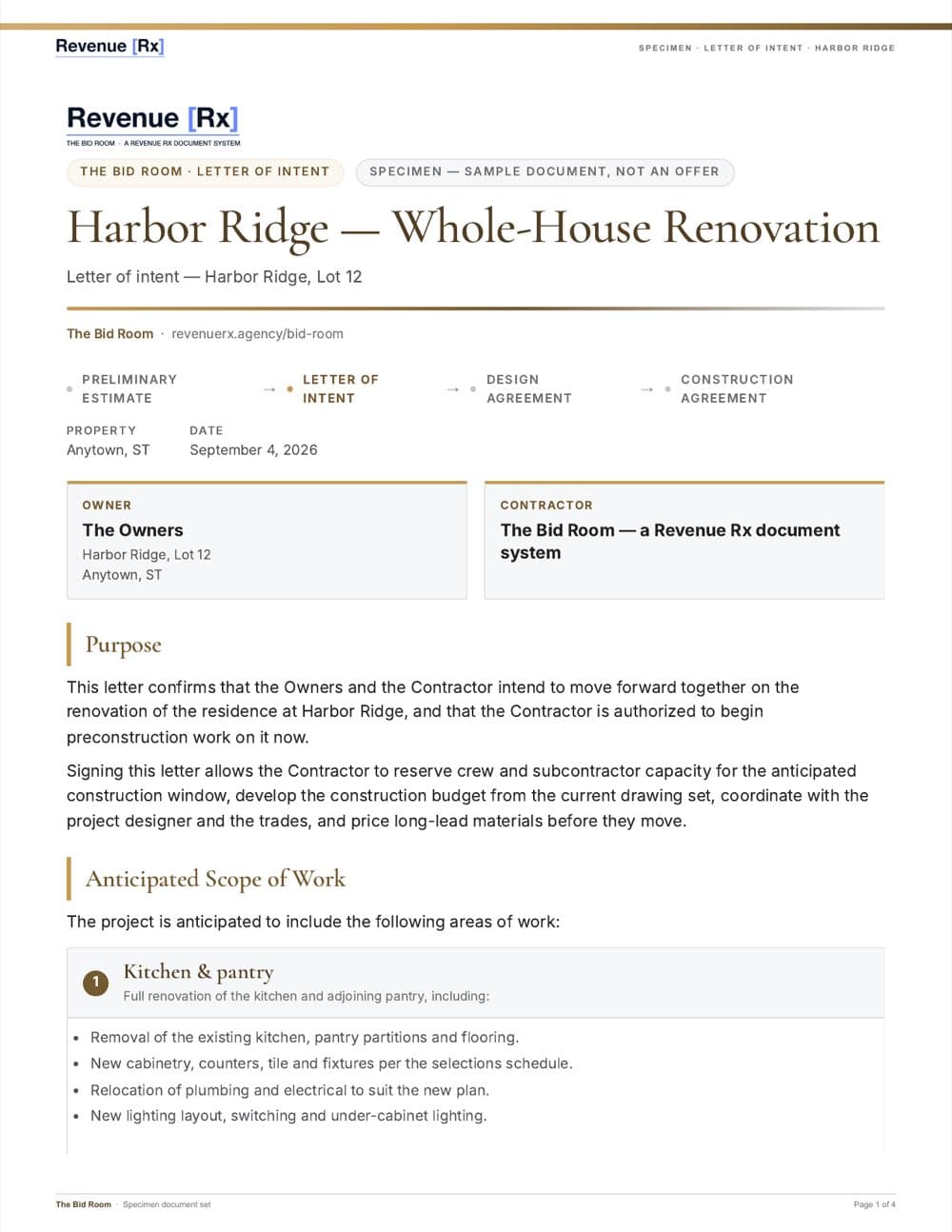
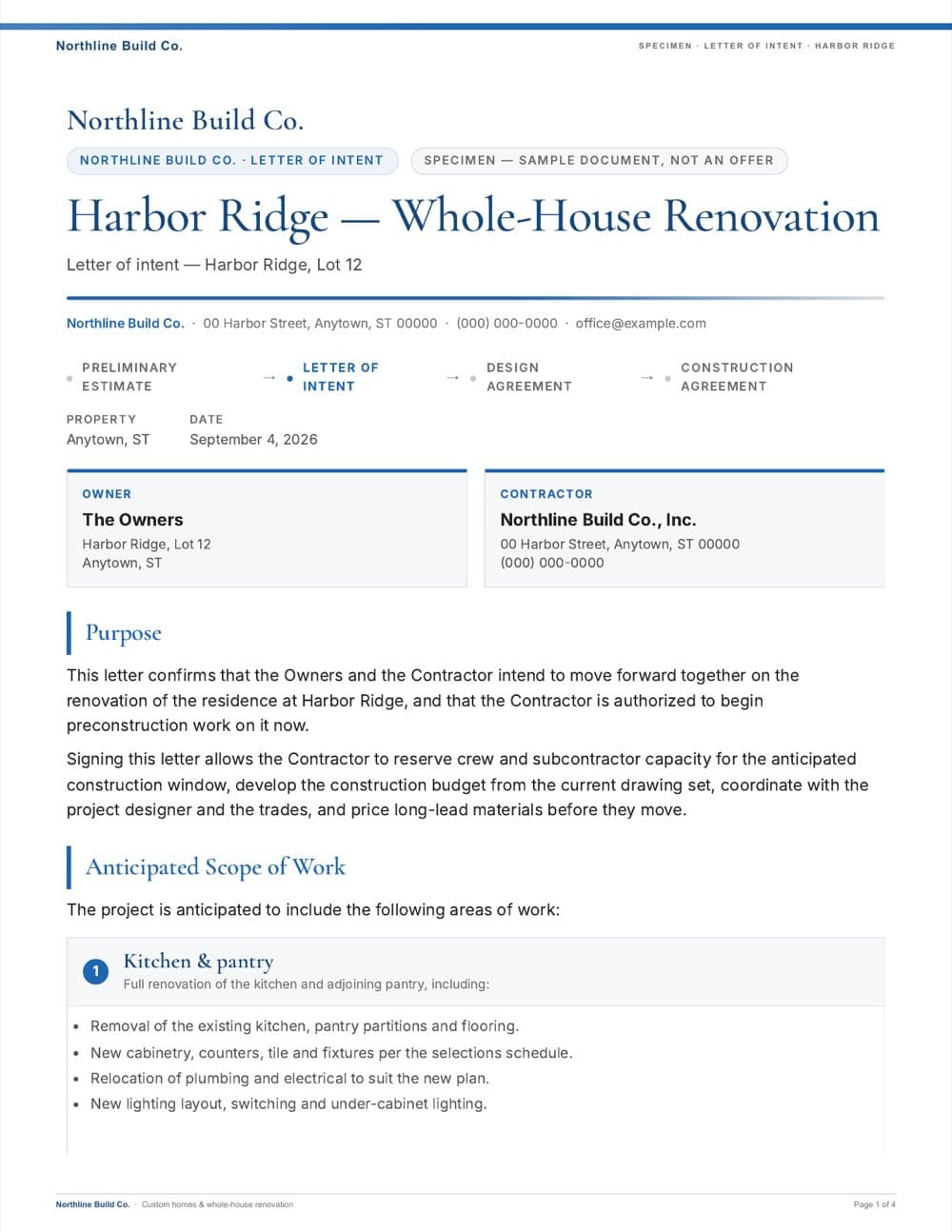
The letter of intent
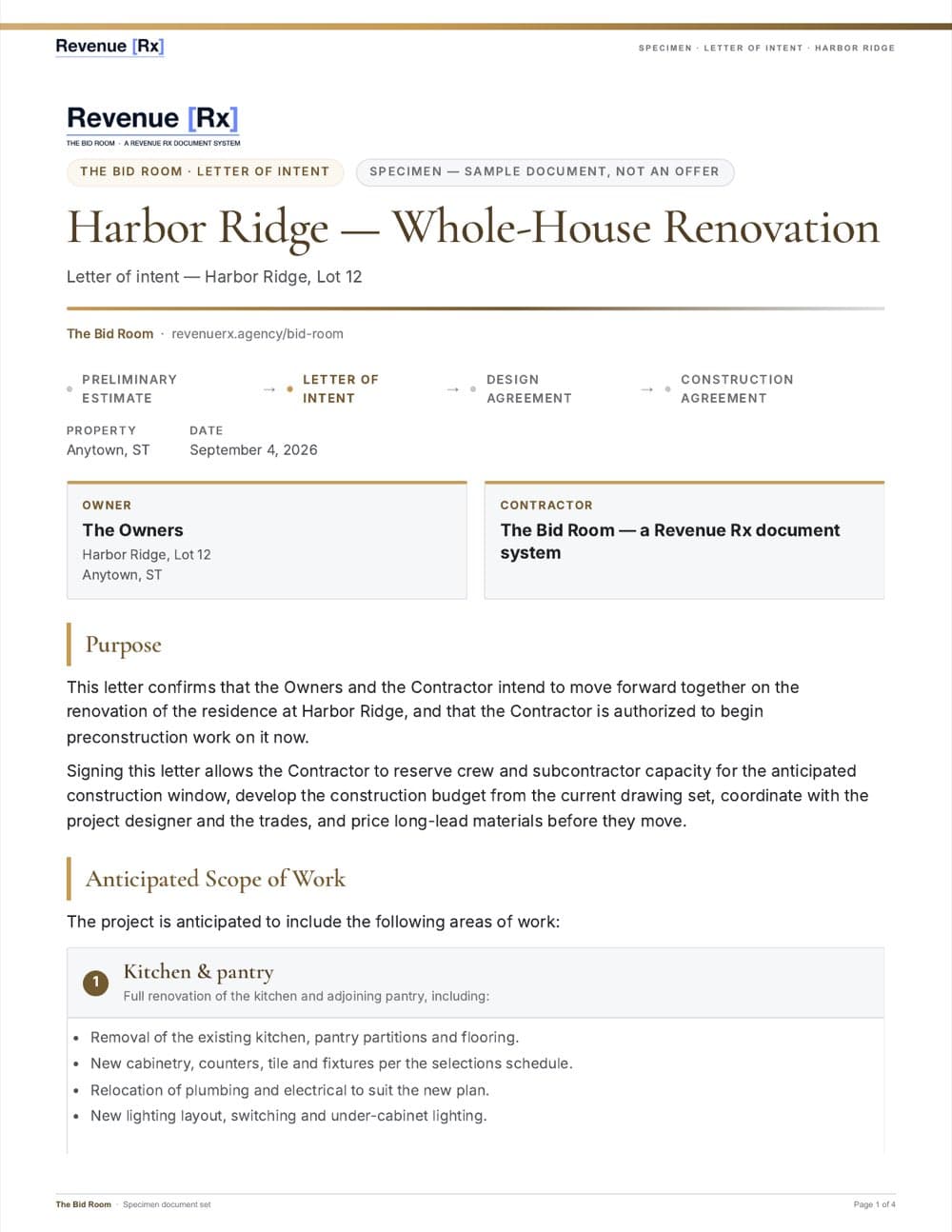
The owner has said yes in principle. Nothing is drawn to construction standard, the subs aren't priced, the schedule isn't held — and you're about to spend a month on all three. The letter of intent makes that work funded and exclusive.
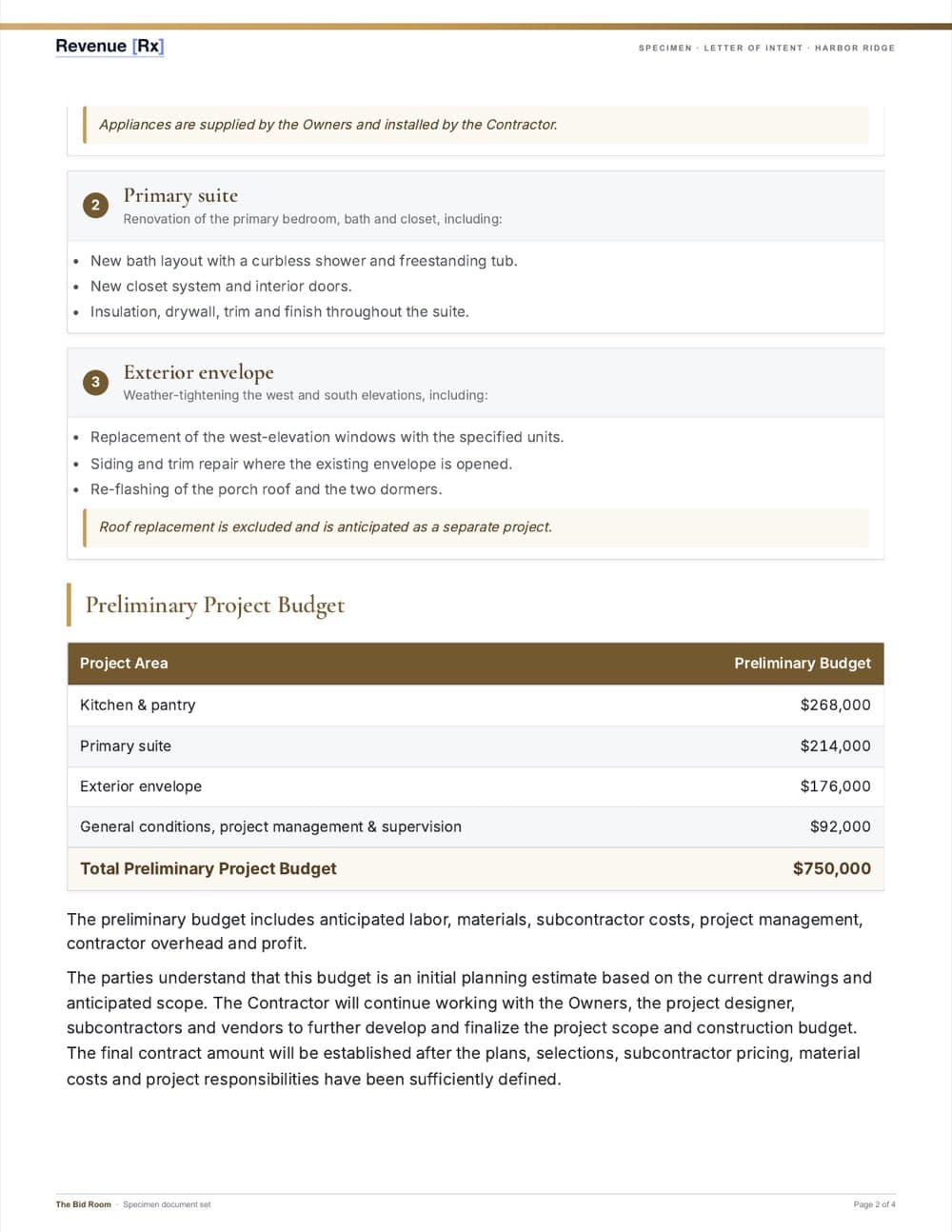
The budget in it is explicitly a planning number, stated as one, which is what keeps a preliminary figure from being quoted back to you as a price twelve weeks later.
- Anticipated scope, area by area, with what's excluded printed beside what's included
- Preliminary budget with the planning-number language attached to it
- Retainer, credited toward the contract sum — or applied against preconstruction time if the job dies
- What the retainer authorises: budget development, sub coordination, vendor pricing, long-lead holds, the permit set
- The construction agreement to come, named, with what it will replace
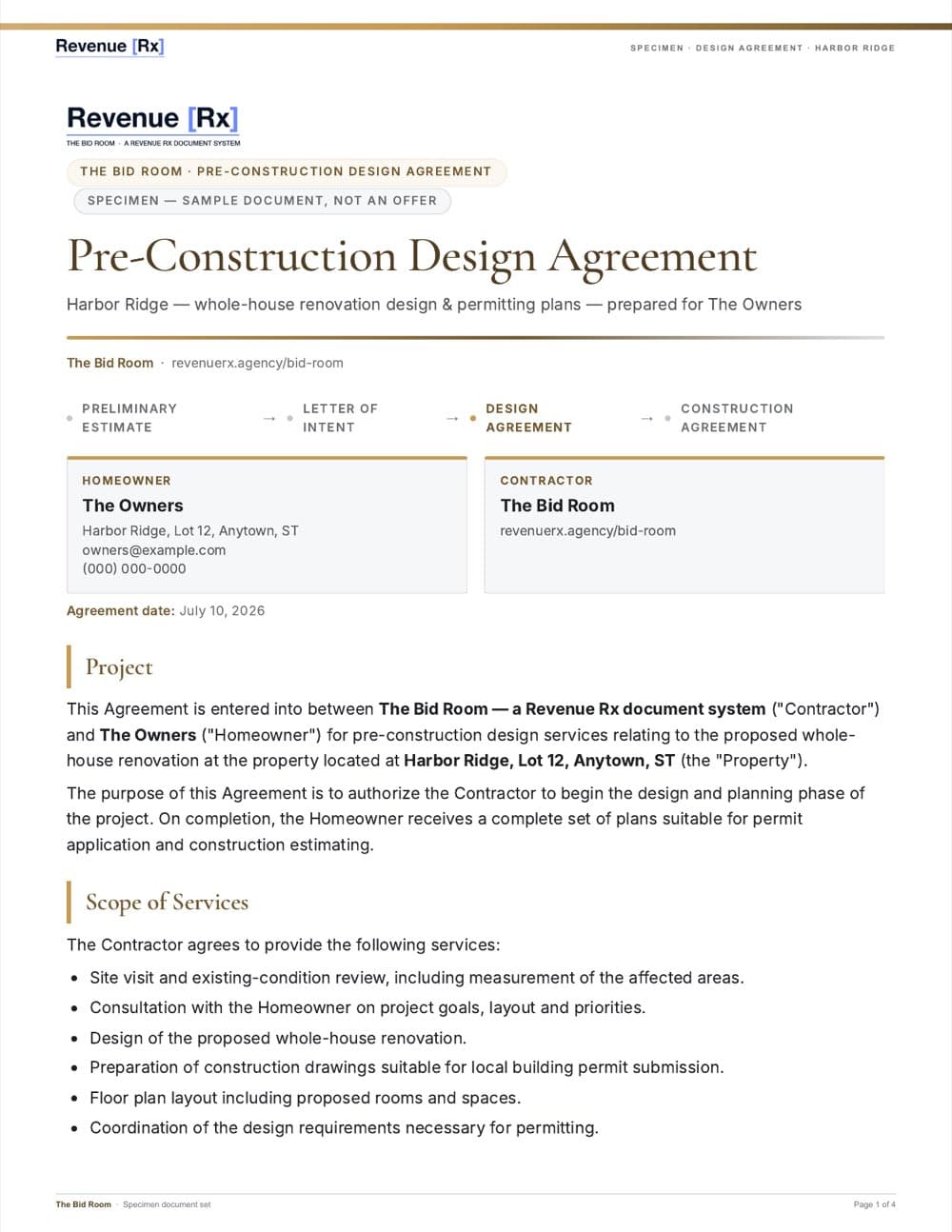
The design agreement
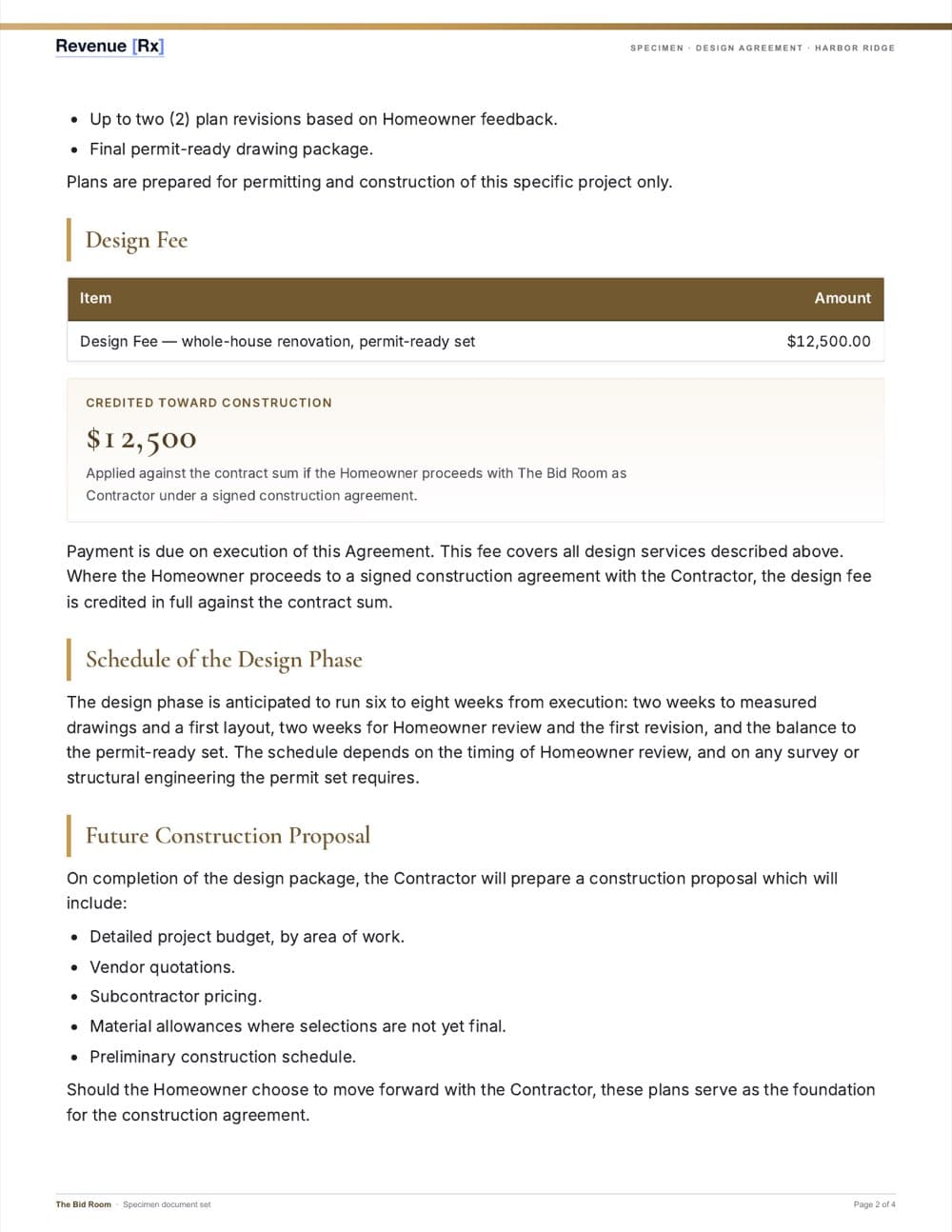
Two clauses in this one do all the commercial work. The fee is credited against the build, so the owner isn't choosing between paying you to design and paying you to build — they are prepaying part of a project they haven't committed to yet. It is the cheapest yes in the whole sequence.
And the drawings stay yours until the fee is paid, and may not be handed to another builder to price. That is the clause that stops a set walking down the street.
- Scope of services — site review, layout, permit-ready drawings, a stated number of revision rounds
- Design fee with terms, and the credit-toward-construction callout on the page where they see the number
- Ownership of documents — yours until paid, this project only, not for another builder's use
- The construction proposal to come: budget, vendor quotes, sub pricing, allowances, preliminary schedule
- Additional services named up front — engineering, survey, septic, permit fees — so none of it reads as a surprise
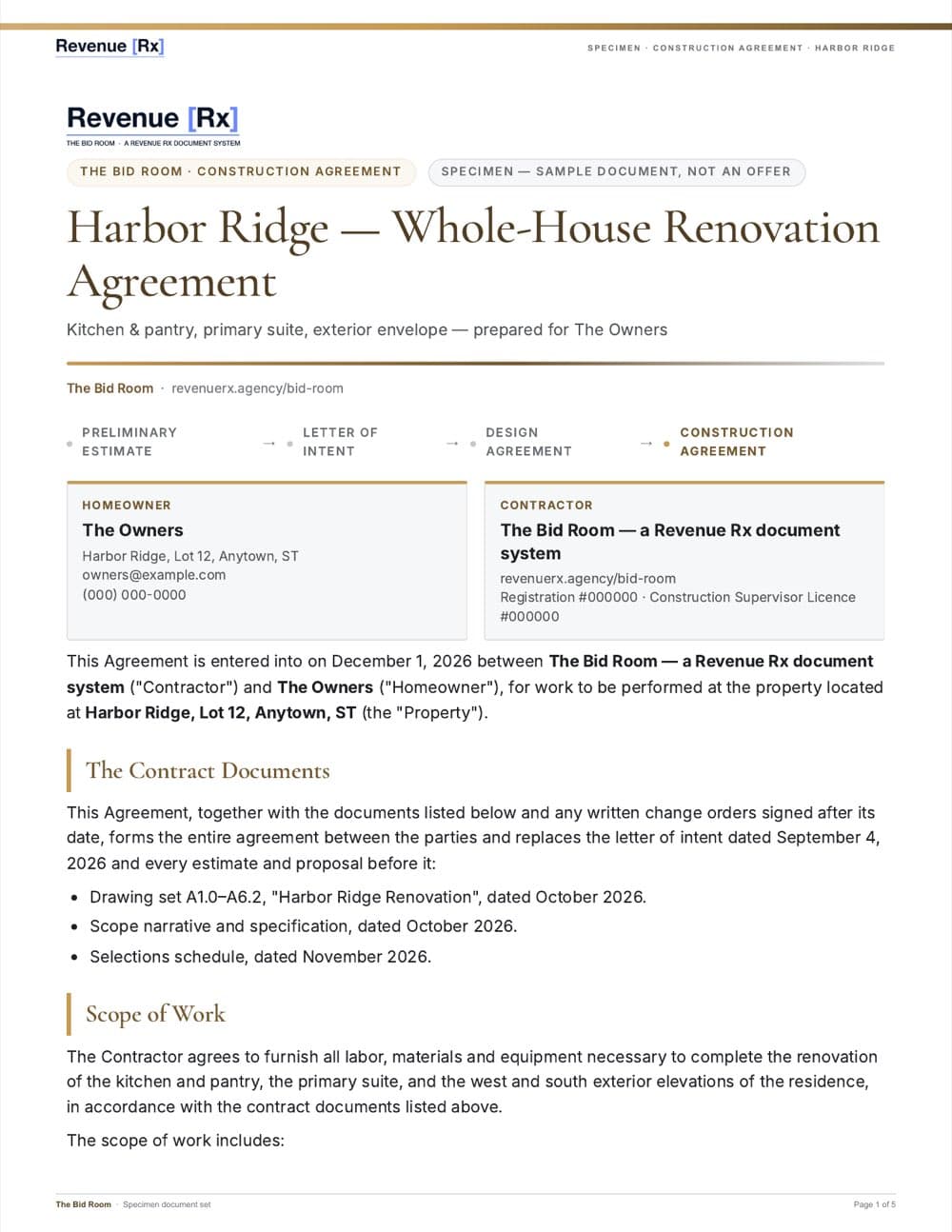
The construction agreement
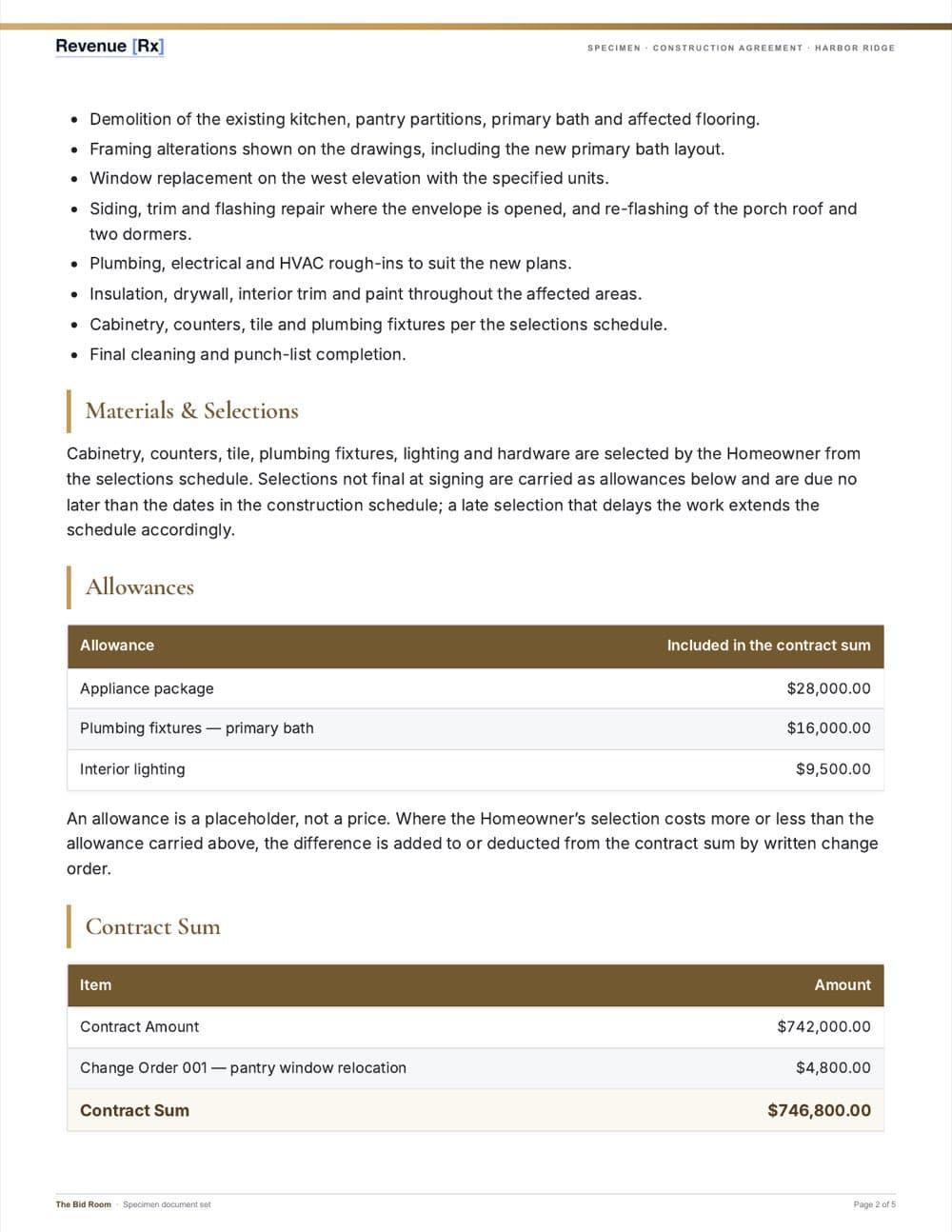
The final build contract, carrying the parts a two-page agreement leaves out and a builder later wishes it had. It names the drawing set, the specification and the selections schedule by date — so “that's not what we agreed” has an answer.
Allowances are stated as allowances, with the written change order that reconciles them. Concealed conditions get priced and signed before the work proceeds, not invoiced after.
- The contract documents — which drawings, which spec, which selections, by date
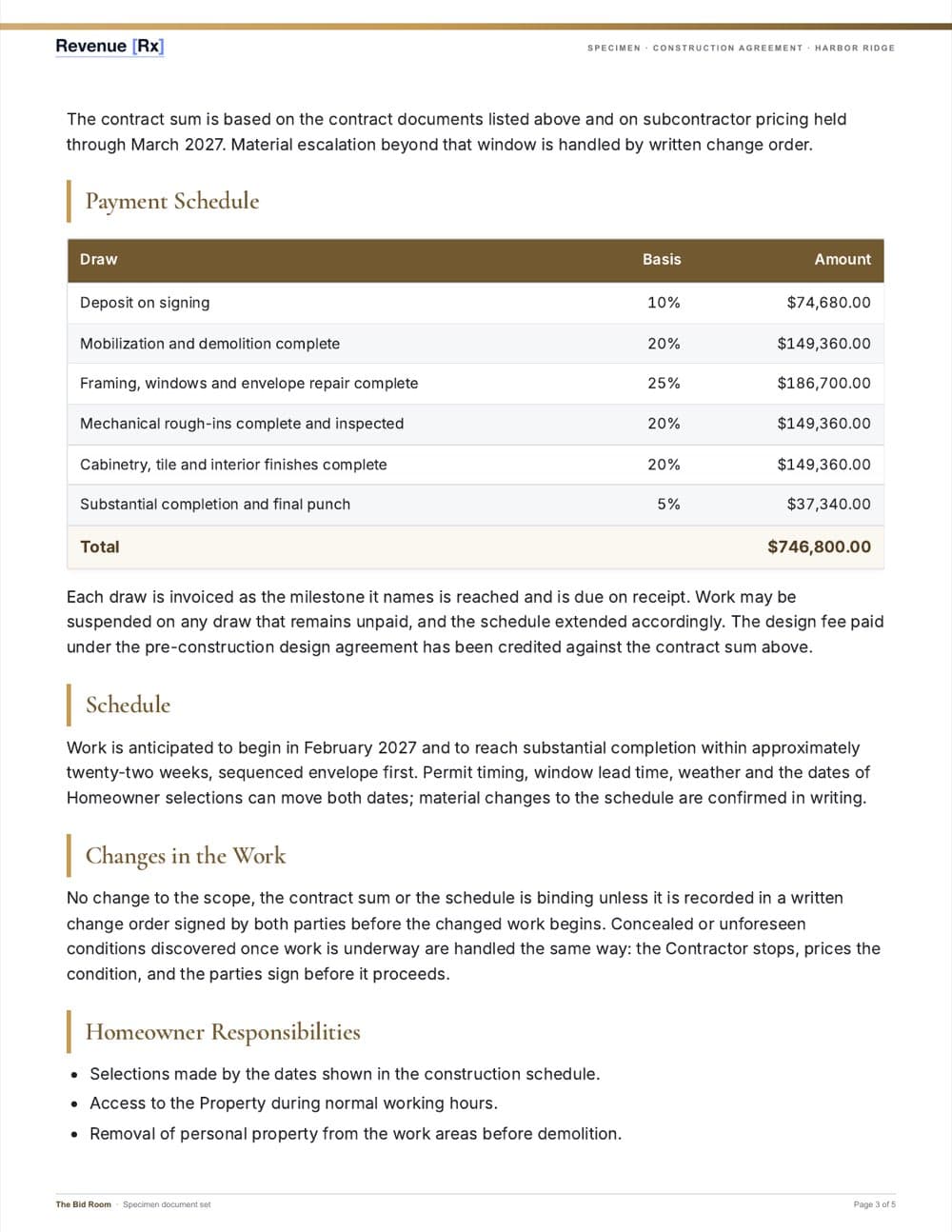
- A draw schedule that adds up — milestone by milestone, checked against the contract sum
- Allowances carried honestly, reconciled by change order
- Written change orders before the changed work begins, concealed conditions included
- Warranty, insurance, permits, termination, dispute resolution — stated, not assumed
- Statutory notices — your attorney's block for your state, printed on every job
One template. Your brand. One hex code apart.
Structure is locked in code so no job drifts from the last one. Everything you own about how it looks — the entity, the signer, the logo, the colour — is one file. The two pages below came out of the same generator on the same job.
What it refuses to print
A template that only formats is a nicer version of the same mistakes. This one reads what you typed and stops when the numbers don't hold.
A draw schedule that doesn't add up
Milestones are totalled against the contract sum before the PDF is written. The single most common defect in a builder's paperwork, caught before it's signed rather than at the last draw.
Statutory notices left blank
Registration and licence numbers, cancellation rights, required warnings — different in every state. The template will not invent them and will not omit them silently: it prints a visible reminder in their place.
A build contract with no warranty
Leave the section out and it says so. What you warrant, for how long, what voids it, and how a claim is made — the argument you do not want to be having for the first time in year two.
The last client's name
Every fill-in file ships blank, the finished set goes to the job's own folder, and any placeholder still sitting in square brackets is listed back to you before you send it.
Where the suite sits
The document suite isn't sold on its own — it's part of the brand kit, because a contract that doesn't look like the proposal that won the job undoes the proposal.
The proposal and the room in your brand, and the letter of intent ready to issue from it — the one document that pays for itself the first time preconstruction runs long.
All three documents in your brand, inside the full brand kit, alongside the estimator desk, the calibrated Quick Estimator and the Portal — and every contract is executed inside the room, which is how the close gets recorded.
When a bid is on the close — a job we brought you, or your own at nothing up front — the LOI and the contract are executed inside the room. That is how a five-percent close becomes a record with its number instead of a memory.
The paperwork, one document at a time
- Estimate, Bid, Quote, Proposal: Which One You Just SentFour words builders use for the same four pages. Each one means something different once it is signed, and the signature line decides which one you sent.
- The Construction Proposal Template, Page by PageA construction proposal template in twelve pages, in the order a homeowner reads them, the omissions that lose bids marked, and what no template covers.
“Templates, not legal advice — reviewed with your attorney before first use.”
Send the contract you use now
Send the agreement you sent your last client — names removed, or left in, whichever you prefer. You get back the same job as the three-document set in your own branding, plus a written list of what your current paperwork leaves open. Free, in your inbox.